



Lewin's theories: what's the difference?
You would have heard about Lewin’s Force Field Analysis theory and the Three-Step Change Model. Both theories were put forward by Kurt Lewin, a German-American psychologist who explored the integration between leadership, change and behaviours. Both concepts are derived from Unit 4 of Business Management, which focuses on businesses adapting to change. Therefore, it is crucial to understand the differences between the two theories that happened to have stemmed from the same founder.
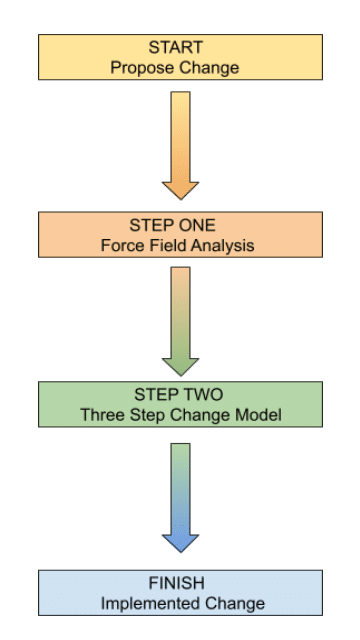
Whilst the Force Field Analysis theory identifies specific forces and measures the extent to which they affect the decision to change, the Three-Step Change Model is more like a step-by-step process for putting the change into action.
Both theories sit within the VCE Business Management Study Design (2023-2027), Unit 4, Area of Study 1: Reviewing Performance - The Need for Change.
In simple terms:
- Force Field Analysis helps a business decide whether it should pursue a change.
- Three-Step Change Model explains how to successfully implement that change.
Both theories are explained in detail below, so let’s get into it!
Lewin’s Force Field Analysis theory
The Force Field Analysis theory is a decision-making tool for businesses looking at whether to pursue a change or not. According to Lewin, when a business plans to create change, it needs to assess:
- the status quo (current state)
- the forces that drive the change (Driving forces)
- the forces that hinder the proposed change (Restraining forces)
Take a look at Figure 1, as this will give you an idea of the Force Field Analysis theory.
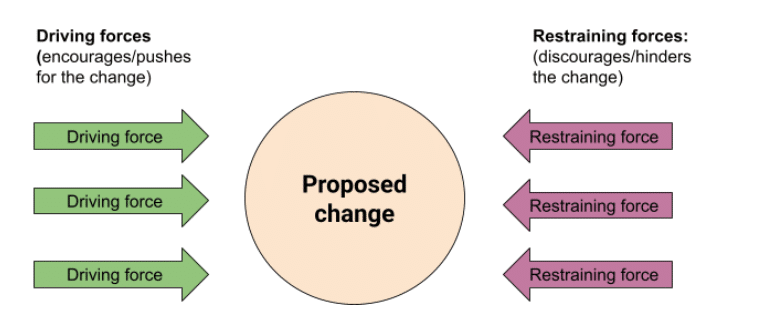
Steps in Lewin's Force Field Analysis
In order to conduct the Force Field Analysis, some steps need to be taken to ensure that the outcomes are optimised. The general process for how a business might perform a Force Field Analysis after a change has been identified is outlined below:
- Identify the Driving and Restraining forces
- Analyse the forces by providing a weighting
- Give a rank for each force
- Reflect and create a plan of action
- Implement the plan
- Reflect and review the results/outcome after incorporating the plan
Note: You may have come across slightly different versions of the theory from various sources. They are all very similar, but stick to what's given in the Study Design, which is:
- Identify the Forces (Step 1)
- Weighting (Step 2)
- Ranking (Step 3)
- Implementation (Steps 4–5)
- Evaluation (Step 6)
How do you know whether the change is successful?
It's important to note that a business may identify as many driving and restraining forces as it can. But what's crucial is to see the overall result after going through the steps listed above, as this can inform the business as to what it needs to do next.
If DRIVING forces > RESTRAINING forces = SUCCESSFUL CHANGE
What this means: the business can pursue the plan to implement the change.
If RESTRAINING forces > DRIVING forces = UNSUCCESSFUL CHANGE
What this means: the business will need to review the plan to implement the change and make any adjustments as necessary before reattempting.
If DRIVING forces = RESTRAINING forces = STATUS QUO
What this means: the business will need to review the plan to implement the change and see how they can increase the number/strength of the driving forces or decrease the number/strength of the restraining forces.
Note
The number and strength of forces are both important to consider, especially during the weighting and ranking stage of the process. A change can have fewer driving forces than restraining forces and still be successful, as the driving forces may carry heavier weight than the restraining forces (and vice versa). So, it is not necessarily just about the number of forces on each side, but also the weighting of those forces.
So, both the steps and the resulting outcomes of the forces, when analysed, form the basis of Lewin's Force Field Analysis.
Lewin’s Three-Step Change Model
Let's move on to the Three-Step Change Model. This is another one of Lewin's theories where the actual process for business change involves three main steps.
1. Unfreeze
- This is where the business prepares for the change by acquiring necessary resources and preparing its employees to disrupt the status quo.
- The manager communicates to employees about the change, the vision and the benefits to reduce resistance and move forward with the next two stages.
2. Change
- This is when the business actually initiates the changes as intended.
- Goal setting and long-term commitment are very important here until the change has been implemented.
- The manager needs to provide ongoing communication and support, such as additional training for employees, as this transition period can be difficult for them.
3. Refreeze
Reaffirming the corporate culture is crucial here so efforts are not reversed. This can be done through rewriting business policies and procedures and providing further ongoing training to employees.
This is when the business ensures that the change has been firmly established to avoid the risk of falling back into old practices.
Force Field Analysis vs Three-Step Change Model
Although these theories are often confused, they serve different purposes.
| Force Field Analysis | Three-Step Change Model |
|---|---|
| Helps decide whether a change should occur | Explains how to implement change |
| Focuses on analysing driving and restraining forces | Focuses on preparing, implementing and sustaining change |
| Decision-making tool | Change implementation model |
| Evaluates the proposed change | Guides the business through the change process |
Practical examples
The following examples are questions taken from past VCE Business Management exams and are based on each of Lewin's theories. Take a look at how you may apply Lewin's theories to the questions. Remember that for some questions, there are multiple possible answers!
Note: Both questions are from Section B; therefore, please read the respective case studies from the VCAA website for more information.

Other blogs
If you need some tips on how to answer questions (and succeed!) in VCE Business Management, check out my other Learnmate blog:
VCE Business Management Study Tips: Definitions, Case Studies & Exam Strategy
Example 1 (VCAA 2025, Section B, Q6)
Possible response plan
- Define terminology: Driving and Restraining forces.
- Apply each step of Lewin's Force Field Analysis to the given case study:
- Norma will need to identify the driving forces/restraining forces that push or hinder the design/installation of the golf holes.
- Norma will then need to analyse the identified driving/restraining forces by assigning a weighting and rank to them.
- After analysis, Norma will need to create and implement a plan of action to add more or strengthen the driving forces and reduce the number or strength of the restraining forces.
- After the plan has been implemented, Norma will need to reflect on and review its outcomes and adjust as necessary. If the driving forces outnumber or are stronger than the restraining forces, then she can go ahead and design/install the new golf holes.
Example 2 (VCAA 2020, Section B, Q3)
Possible response plan
- Define terminology: Unfreeze.
- Apply to the case study: The CEO of Manitta Mining will need to prepare the business for change by unfreezing the status quo and communicating to employees about the change (initiated due to the increasing number of workplace accidents), its benefits and vision to reduce as much resistance as possible.
- Define terminology: Change.
- Apply to the case study: Next, the CEO will need to actually implement the change whilst providing ongoing communication and support to employees during this period. This may be done through additional training on safe work practices and giving employees feedback and evaluation on their work.
- Hint: You can add some extra detail here from Unit 3, AOS 2 (training options and performance management strategies).
- Define terminology: Refreeze.
- Apply to the case study: Finally, the new change will need to be cemented in Manitta Mining's culture to avoid reverting to old, unsafe practices. This may be done through updating or rewriting policies and procedures to reflect the most recent work-safe practices.
Conclusion
To wrap up, I hope these examples help to show you how to apply the two theories to exam questions. Please remember, this is just my take on these questions, and you can totally take a different approach, as long as you are relevant to the requirements of the question at hand.
Despite the differences between both theories, they are also strongly connected. Whilst the Force Field Analysis is used to evaluate a proposed change, the Three-Step Change Model can then be applied to implement the change (Figure 2).
Thanks for reading and all the best!
Get Help with VCE Business Management
Looking for support in VCE Business Management? Learnmate's research shows that 70% of students who achieve an ATAR of 99 or above engage one or more tutors. Find yours today:
This blog was written by Nanditha S, an experienced and dedicated VCE Business Management and Economics tutor on Learnmate. You can view Nanditha's profile, including her glowing reviews and, subject to her availability, request Nanditha as your tutor here. Alternatively, you can see and connect with other Expert VCE Business Management Tutors on Learnmate at any time.