


Hello! My name is Nanditha, and as a VCE Business Management tutor who achieved a raw score of over 40 in 2020 and having tutored now for over 5 years, I’m excited to share some valuable insights to help you excel in this subject.
I'm one of many VCE Business Management tutors on Learnmate who've scored highly and can help you develop these skills. Below, you'll find tips, explanations, and examples to help you maximise your VCE Business Management performance.
1. Mastering Definitions
There are a lot of these in VCE Business Management (BusMan) and they form the base of this subject. Know your definitions and you’ve done yourself a huge favour. Go ahead and memorise them using any technique you find helpful (flash cards, using sticky notes, quizzing yourself, etc.).
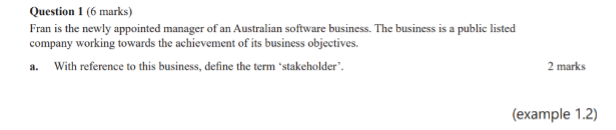
For example, you might encounter a straightforward definition question in your SAC or exam:

These are easy marks, so make sure you're prepared.
Alternatively, definitions might be embedded in a larger case study question:
Tip: Use definitions as the starting point in your extended responses. If you're unsure how to begin a high-mark question, start by defining the key term(s).
2. Applying Theory to Case Studies
So, you’ve learned the BusMan theory from class and your textbook. Amazing! Now, probably the most important part of BusMan is about demonstrating your ability to apply that theory to hypothetical business scenarios. It’s good to remember that there is no “Golden Rule” or one specific method as to how you apply knowledge to case studies, but it’s important to show that you can do it. Below are some tips on how along with a sample question and response (see example 2.1).
- Use the Business/Individual’s Name: Acknowledge the name of the business or individuals in your response. This shows that you've read and understood the case study.
- Integrate Business Operations: Pay close attention to the business's operations, management practices, and CSR initiatives mentioned in the case study.
- Quote Directly from the Case Study: This is particularly useful when the case study includes a transcript or dialogue between key figures like the CEO or managers.
Example Question (2.1)
Tedros Tyres is an Australian-based tyre manufacturer that produces different types of tyres. Recently, the operations manager, Rhian Rogers, has been instructed to seek out strategies to improve their operations system. The business has recently set a new objective to improve the quality of its tyres by the end of 2026.
Describe how implementing quality assurance at Tedros Tyres could assist them in improving their operations.
Sample Response:
Quality assurance is the process of achieving a specific standard of quality through certification from an independent body that assesses the operations system of a business. The operations of Tedros Tyres can be improved by preventing errors in manufacturing the tyres before they even occur. Since Quality assurance is a proactive approach, this will enable Tedros Tyres to avoid halts in their tyre production and therefore enhance the efficiency of the production process. In regard to improving effectiveness, customers seeking to purchase tyres will be more willing to obtain them from Tedros Tyres as the Quality assurance provides a certified endorsement of the quality of the tyres. This will likely increase the number of sales for Tedros tyres and ultimately reciprocate greater profits as a result of its improvements in tyre quality.
Breakdown of Sample Response:
First, the key term is defined. In this case, a definition of Quality assurance is provided.
A link to efficiency is provided. Note that “Tedros Tyres” has been used early in the response, after the definition.
Further explanation is given in regard to what Quality assurance does to improve the efficiency operations system.
A link to effectiveness is provided.
Further explanation is given in regard to what Quality assurance does to improve the effectiveness operations system.
Tip: Skim the questions before reading the case study. This way, you’ll know what information to look for, such as mentions of technology or specific management strategies. For instance, if one of the questions is about technology, look for something in the case study that mentions CAD or automated production lines.
3. Understanding Task Words
These “command” words are very important and are often used to guide in writing a specific type of answer. For example, “evaluate” means to provide the advantages and disadvantages of the topic posed in the question. Whereas “compare” is asking you to give similarities and differences between two or more objects/features. Therefore, it is crucial to understand what each task word means so your answer reflects how they want you to form it.
Over time, you will find that you become quite automatic at knowing what each one requires you to do. So, find a list from any reputable source (school, textbook, online) and keep it handy when answering practice questions.
4. Structuring Your Responses
Clear and structured responses make it easier for your teacher or examiner to award marks. Here’s how you can structure your answers effectively:
- Start with a Topic Sentence: Define key terms or directly answer the question using words from the question.
- Use Sentence Structure Words: These words can help make your writing more seamless. Examples include "Similarly," "In contrast," "However," "Ultimately," and "An/one advantage is..." Here's a list of "sentence structure" words you can use:
• Similarly…
• One similarity…
• Another similarity…
• One difference…
• Another difference…
• Likewise…
• In contrast…
• Contrastingly…
• However…
• Ultimately…
• In the end…
• Overall…
• A/one advantage…
• Another advantage…
• A/one disadvantage is…
• Another disadvantage is…
• A/one benefit…
• A/one consequence…
5. Adding Additional Examples
While not always required, incorporating your own examples can set you apart. It demonstrates that you can apply Business Management theory to real-world situations. Accordingly, it's a good idea to keep up with and maintain a record of recent business news as it might prove useful for your SACs and exams. There is a possibility that a question may ask you to mention a "contemporary" business example, meaning that you need to know real businesses and what they do that relates to concepts in BusMan (see example 5.1 below as an example).

6. Practice Makes Progress
There is a podcast called “Kwik Brain” by Jim Kwik. The host shares insightful tips and tricks about how to maximise your brain’s performance for any aspect of life. One episode I listened to mentioned a key idea that “Practice makes Progress”.
So, in saying this, I would suggest applying your knowledge to practice questions. Get out those textbook questions, mock SACs/exams and do them. They can tell you your strengths and weaknesses in the entire subject.
If you're finding specific topics consistently difficult, this is where working with a VCE Business Management tutor can make a real difference — targeted one-on-one feedback on your responses is something you can't get from a textbook alone.
Bonus Tips:
- Keep a copy of the VCE Business Management Study Design handy. This document outlines everything you need to know and is an essential tool for SAC and exam preparation.
- Use your teacher and peers. Feedback is a very important part of the continuous improvement process. When you ask for feedback, you can identify what you need to work on as well as learn something new when interacting with your support system.
- Sit past VCE Business Management papers, then debrief with the official examiner reports to see what high-scoring responses do and common pitfalls to avoid. You can find past exams and examiner reports here: VCE past exams and examiner reports. Track mistakes and turn them into a checklist for next time.
Get Help with VCE Business Management
Learnmate's research shows that 70% of students who achieve an ATAR of 99 or above engage one or more tutors. Find yours today below.
Conclusion
This article is intended as a study reference for VCE Business Management. Remember, your belief in yourself and your self-confidence will drive your success. Best of luck with your studies and future endeavours!
FAQs
Aim for 5–7 hours per week of active study outside class time, split between memorising definitions, practising case study responses under timed conditions, and reviewing past exam questions with the VCAA examiner reports. In the final month before the exam, increase this to 8–10 hours with at least one full timed paper per week. Quality matters more than quantity — one hour of timed practice responses is worth more than three hours of re-reading notes.
A VCE Business Management tutor can provide targeted feedback on your written responses — something a textbook can't do. Specifically, a tutor can help you refine your use of command terms (explain vs evaluate vs discuss), improve how you apply theory to case study scenarios, sharpen your definition recall, and develop the exam technique that separates a 35 from a 40+. Tutors on Learnmate who have scored highly in Business Management understand the specific marking criteria and can identify where you're losing marks before your SAC or exam.
Start with the VCAA Study Design (2023–2027) as your content checklist — it outlines everything that can be assessed. Past VCAA exam papers and examiner reports are essential for understanding what high-scoring responses look like and where students commonly lose marks. Your textbook covers the theory, but applying it to case studies under timed conditions is what builds exam readiness. For personalised support, browse VCE Business Management tutors on Learnmate.
Business Management is considered one of the more accessible VCE subjects because the concepts are intuitive and relatable. However, the exam demands precise definitions, structured responses and the ability to apply theory to unfamiliar case studies under time pressure. Students who treat it as a "common sense" subject and don't practise the specific exam format tend to underperform. With consistent definition work and regular timed practice, high study scores are very achievable.
Memorise all key definitions from the study design first — they're the foundation of every response. Then practise applying theory to case study scenarios under timed conditions, using past VCAA papers and examiner reports to understand what examiners reward. Focus on mastering command terms so your response structure matches what the question asks for. In the final month, sit at least one full timed paper per week and keep a record of every mistake.
Business Management typically scales down slightly at mid-range study scores, similar to other high-enrolment VCE subjects. However, the scaling impact is small — a strong raw score will always serve your ATAR well regardless of minor adjustments. Choose subjects based on your strengths and interests rather than scaling alone. For a detailed explanation of how VCE scaling works, see our What is the ATAR? guide.
Looking for support in VCE Business Management? Learnmate's research shows that 70% of students achieving ATARs of 99+ engage one or more tutors. Research from Evidence for Learning confirms that one-to-one tuition adds the equivalent of five additional months of academic progress.
Browse VCE Business Management tutors | Post a tutoring job
This blog was written by Nanditha S, an experienced and dedicated VCE Business Management and Economics tutor on Learnmate. Since graduating in 2020, Nanditha has been studying Environmental Engineering and Commerce at Monash University, with a major in Behavioural Commerce. She has received accolades for her achievements in Business Management and Economics, and she brings her passion for these subjects into her tutoring.
You can view Nanditha's profile, including her glowing reviews and, subject to her availability, request Nanditha as your tutor here. Alternatively, you can see and connect with other Expert VCE Business Management Tutors on Learnmate at any time.