


Online tutoring has surged in popularity since COVID-19 — but the big question remains: does it work as well as face-to-face? Short answer: yes, for most learners, when it’s done well. Below, we unpack the evidence and the real-world pros and cons so you can choose the format that fits you (or your child) best in 2026.
Is online tutoring effective? What the research says
Multiple large reviews and recent trials show that tutoring delivered online can produce learning gains comparable to face-to-face — and sometimes better — when three ingredients are present: regular sessions, clear goals aligned to the curriculum, and rapid, specific feedback. In other words, consistency and quality drive results more than the delivery mode.
In Australia, Evidence for Learning found that one-to-one tuition delivers an average of five additional months of academic progress. The impact is even greater for primary school students (+6 months) compared to secondary students (+4 months). Crucially, studies involving digital technology show broadly similar effects to in-person tutoring— meaning online delivery does not diminish the benefit when session quality is maintained.
Research at a glance
| Study | Key finding |
|---|---|
| Evidence for Learning (Australia) | 1:1 tuition can result in +5 months progress overall over a period of about 10 weeks of regular tutoring. Primary students gain +6 months vs +4 months for secondary. Digital (online) delivery shows broadly similar effects to in-person in terms of overall impact. |
Meta-analysis (PreK-12) | A large review of dozens of high-quality tutoring experiments across primary and secondary school found that tutoring reliably improves results and results in large gains - especially when it’s 1:1 or in small groups with regular sessions. |
| Secondary maths - online (Spain) | A randomised trial in Spain tested an eight-week, fully online maths program delivered in pairs after school by qualified teachers. The trial produced significant improvements and students lifted standardised maths scores and end-of-year grades and were less likely to repeat a year. |
Middle school - online 1:1 (Italy) | An Italian program matched under-served middle-schoolers with university tutors for about three hours/week of individual online tutoring. Students saw increased maths performance, with student performance rising by roughly 0.20–0.23 standard deviations, with 1:1 tutoring and higher dosage driving the strongest gains. |
Early literacy - online (US) | The first randomised trial of fully virtual early-reading tutoring (K–2) ran four 20-minute sessions per week across 12 US schools; tutored students outperformed peers on key early-reading measures (e.g., phonics, decoding, fluency) and saw relative overall boosted K-2 reading skills. First graders gained the equivalent of 30 additional days of school. |
| K12 Tutoring — ESSA validated (US, 2025) | K12 Tutoring earned ESSA Level II and Level III validation in 2025 based on independent, third-party studies demonstrating significant academic gains in reading and maths through live, small-group virtual instruction. |
| What matters online | Rapid evidence reviews on remote learning found the biggest levers of effective online learning were clear goals and teaching quality, active engagement, and timely, specific feedback—the “how” of the lesson matters more than the “where.” |
One important caveat: attendance matters
Research consistently shows that online tutoring works best when students attend regularly. A 2025 Hechinger Report analysis of US tutoring programs found that students who completed at least 20 sessions over 10 weeks saw reading gains in line with in-person tutoring — but attendance can be rocky, particularly for less motivated students.
The takeaway: consistency is key. On Learnmate, flexible scheduling and the ability to choose a tutor who’s the right personality fit help keep students engaged and showing up.
Benefits of online tutoring: convenience and flexibility
One of the biggest advantages of online tutoring is convenience. With a reliable internet connection, students can learn from anywhere and fit sessions around busy schedules — sport, music, part-time work, you name it. Many platforms also allow recordings, so students can revisit tricky explanations in their own time.
- Learn anywhere, no commute
- Easier to schedule (and reschedule)
- Replay explanations if recordings are enabled
Accessibility: find the right expert beyond your postcode
In-person options are limited to who lives nearby. Online, you can search a much wider pool to find the best subject-and-personality match — a major driver of learning outcomes. On Learnmate, this happens every day: a Year 12 student in regional NSW working seamlessly with an online English, maths or science tutor based in WA — because they’re the right fit.
Whether your child is studying VCE, HSC, IB or QCE, online sessions connect them with specialist tutors across every curriculum — not just the ones available locally.
How online tutoring works on Learnmate
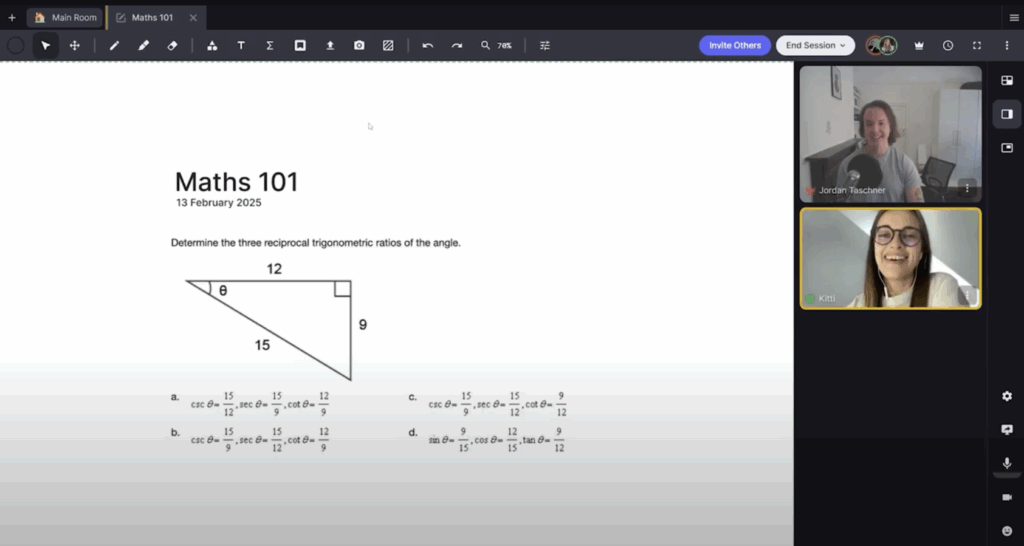
Online lessons on Learnmate are delivered through Lessonspace — a purpose-built virtual classroom designed specifically for tutoring, not just video calls. Students join by clicking a link in their browser. There's nothing to download, install or sign up for.
Inside the session, tutors and students share a collaborative workspace that includes:
- Interactive whiteboard — an infinite shared canvas where both tutor and student can write, draw and annotate simultaneously. Subject-specific tools include an equation editor for maths and science, graphing tools, and shape and text tools for diagrams.
- Document sharing — tutors can upload worksheets, PDFs, images or past papers directly into the session and annotate them in real time. A built-in resource library means materials can be pulled up instantly without leaving the lesson.
- Video and audio — clear two-way video and audio powered by WebRTC, plus text chat and screen sharing for step-by-step walkthroughs.
- Tutor control — tutors can lock the board to present, then unlock it when it's the student's turn to work through a problem. This keeps sessions focused and structured.
The result is a session that mirrors the best parts of a face-to-face lesson — collaborative problem-solving, live feedback, real-time annotation — without the commute.
Ready to try it? Browse online tutors on Learnmate across 110+ subjects.
Safety and comfort: learning in a secure environment
Online lessons take place in a safe, familiar setting at home. Learnmate prioritises the safety and wellbeing of students and tutors through a secure platform and best-practice guidance. For younger learners, Learnmate recommends lessons are supervised or within earshot of a parent or responsible adult.
Cost-effectiveness: what families actually pay in 2026
Online tutoring often reduces the total cost of learning by removing travel time and expenses. On Learnmate, online 1:1 tutoring is typically $12–25 cheaper per hour than in-person lessons. Hourly rates start from around $30/hour for newer tutors building their profile, with additional savings available when prepaying for lesson packages. That keeps high-quality support accessible for more families.
For context, the average across all subjects and year levels on Learnmate was approximately $65/hour in 2025. English averages around $58.50/hour, Maths $62.50/hour, and Science $70.50/hour. Online tutors are typically on the lower end of these ranges.
How often should online tutoring sessions be?
Evidence for Learning’s research suggests that optimal results come from short, regular sessions of roughly 30 minutes, 3–5 times per week over a set period of up to ten weeks. This is particularly true for primary school students. For Year 11–12 students, Learnmate’s own data suggests longer sessions of 1–1.5 hours, 1–2 times per week, tend to work best.
The research also found that tutoring works best when it’s additional to and explicitly linked with normal classroom lessons — so we recommend discussing your child’s schoolwork with their tutor so sessions can be tailored accordingly.
Potential drawbacks — and how to manage them
Online tutoring isn’t perfect for everyone. Here’s how to address common challenges:
- Fewer non-verbal cues? Build in frequent “check-for-understanding” moments, use the whiteboard, and ask the student to “teach back” key steps.
- Tech hiccups? Do a quick device/internet check before lesson one; agree on a hotspot or reschedule plan in advance.
- Attendance slipping? Choose a tutor who’s the right personality fit, set a consistent schedule, and keep sessions short and focused — especially for younger students.
- Needs in-person structure? Some students stay more focused face-to-face — that’s okay. Choose the format that keeps them engaged and confident.
Bottom line: pick the format that fits the learner
Both formats can deliver excellent results. The biggest predictors of success are consistency, tutor quality and feedback cadence — not whether the lesson is on a screen or at a table. If travel or time is a barrier, online tutoring usually wins on convenience without sacrificing effectiveness.
On Learnmate, you can browse hundreds of online tutors across 110+ subjects, filter by year level, curriculum and price, and book a session that fits your schedule.
How to trial online tutoring in 3 simple steps
- Book a 30–45 minute session focused on one clear goal (e.g., “factorising quadratics” or “topic sentences”).
- Agree on what success looks like by the end of the session.
- Review the fit together: Did you learn something new? Did you feel engaged? Would you like to keep going?
FAQs
Yes. Research from Evidence for Learning and multiple international trials confirms that when lessons are regular, goals are clear, and feedback is timely, online tutoring produces gains comparable to face-to-face for most students. Evidence for Learning specifically notes that studies involving digital technology show broadly similar effects.
When you book an online session, both the tutor and student receive a link to a Lessonspace virtual classroom. Lessonspace is a purpose-built online tutoring platform — not a generic video call. Inside the session, you share an interactive whiteboard where both participants can write and draw simultaneously, upload and annotate documents like past papers and worksheets, use subject-specific tools including an equation editor and graphing tools, and communicate via clear two-way video, audio and text chat. There's nothing to download — it runs in your browser on any laptop, tablet or desktop. For younger learners, Learnmate recommends that a parent or responsible adult is nearby during sessions.
It can — particularly for structured early literacy and numeracy. Evidence for Learning found that primary school students actually benefit more from 1:1 tuition (+6 months progress) than secondary students (+4 months). Keep sessions short and frequent (around 30 minutes), and ensure a parent is nearby to support focus and setup.
A laptop or tablet, reliable internet, a quiet space, and ideally a headset and webcam. A stylus or tablet is handy for maths and science working. Learnmate's online classroom (Lessonspace) runs in any modern web browser — there's nothing to download or install. Students just click the session link to join.
Rates vary by subject, level and tutor experience. On Learnmate, online 1:1 tutoring typically ranges from $55–$95 per hour, with rates starting from around $30/hour for newer tutors. The platform average is approximately $65/hour. You can also save with prepaid lesson packages. For a full breakdown, see our pricing guide.
Use Learnmate’s filters for subject, year level, availability and price. Read profiles and reviews, then shortlist two or three tutors and book an initial session to check the fit.
Clear objectives, interactive tools (whiteboard/doc sharing), active questioning, and specific, actionable feedback during the lesson.
Absolutely. Senior students benefit from targeted practice, exam strategies and syllabus-aligned feedback — all of which translate seamlessly to online lessons. Students in Year 12 often know what they want from sessions and can be more prescriptive around lesson format, focus and delivery. Learnmate's research shows that 70% of students who achieve ATARs of 99+ engage one or more tutors.
Pick the option that maximises attendance, focus and tutor fit. If travel or time is a barrier, online usually wins. If a student needs the physical structure of face-to-face, choose in-person. Many students on Learnmate start online and stay online — the flexibility and wider tutor pool outweigh the perceived benefits of in-person for most learners.
Have a backup plan (e.g., phone hotspot) and an agreed reschedule policy with your tutor before the first session.
Ready to get started?
Learnmate's research shows that 70% of students achieving ATARs of 99+ engage one or more tutors. Research from Evidence for Learning confirms that one-to-one tuition adds the equivalent of five additional months of academic progress.