


The VCAA's 2025 Scaling Report has now been released and it offers valuable insight into how each VCE subject was scaled and contributed to final ATAR scores in 2025. Whether you're in Year 10 and choosing your VCE subjects, in Year 11 strategising for Year 12 in 2026 or have just completed Year 12 in 2025, understanding how subjects were scaled is essential.
What Is Scaling and Why Does It Matter?
Scaling is the process undertaken by the VCAA of adjusting raw subject study scores to a final "scaled study score" to account for the relative difficulty and competitiveness of each subject. This ensures fair comparison across subjects, as well as across students in the State who each select a unique combination of subjects to study.
It is necessary as not all subjects are created equal - some are easier than others, and the corollary of that is also that some subjects are much more difficult than others. Without scaling, a raw 40 in a highly competitive and technically difficult subject like Specialist Mathematics would be treated the same as a raw 40 in a less academically concentrated subject. Scaling corrects this by examining:
- The relative difficulty of the subject
- The academic strength of the students taking it
This process ensures that no student is advantaged or disadvantaged simply because of their subject selection.
Understanding Your Raw Study Score
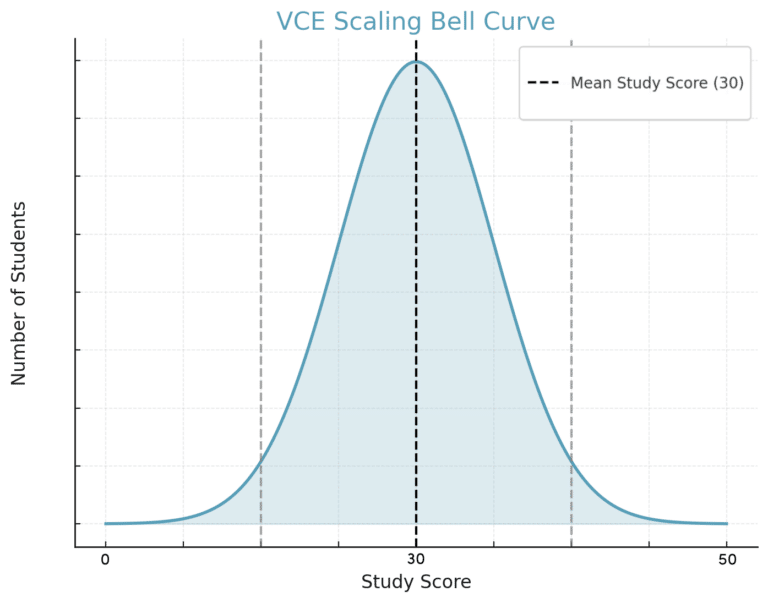
Your "raw" study score (a number between 0–50) represents how your performance compares to everyone else completing that subject.
- Average (mean): 30
- Majority of students: Between 20 and 40
- High achievement: 40+
This distribution follows a bell curve, where most students sit near the middle as per the below.
How Scaling Works
Once raw scores are calculated, they’re adjusted (or 'standardised') across the State to reflect the subject’s overall cohort strength. This means that a raw score in a competitive (and more challenging) subject may scale up considerably, while a raw score in a less competitive (and less difficult) subject may remain similar or scale slightly down.
Examples of Raw vs Scaled Scores (2025 Figures)
| Subject | Raw 35 | 2025 Scaled Score |
|---|---|---|
| English | 35 | 33 |
| Mathematical Methods | 35 | 41 |
| Health & Human Development | 35 | 31 |
| Specialist Mathematics | 35 | 48 |
| Psychology | 35 | 34 |
Which VCE Subjects Scaled Up and Down the Most in 2025?
Language subjects and advanced STEM subjects typically have the strongest scaling due to highly competitive cohorts and challenging content, while more creative and practical subjects tend to me scaled down for being less academically challenging.
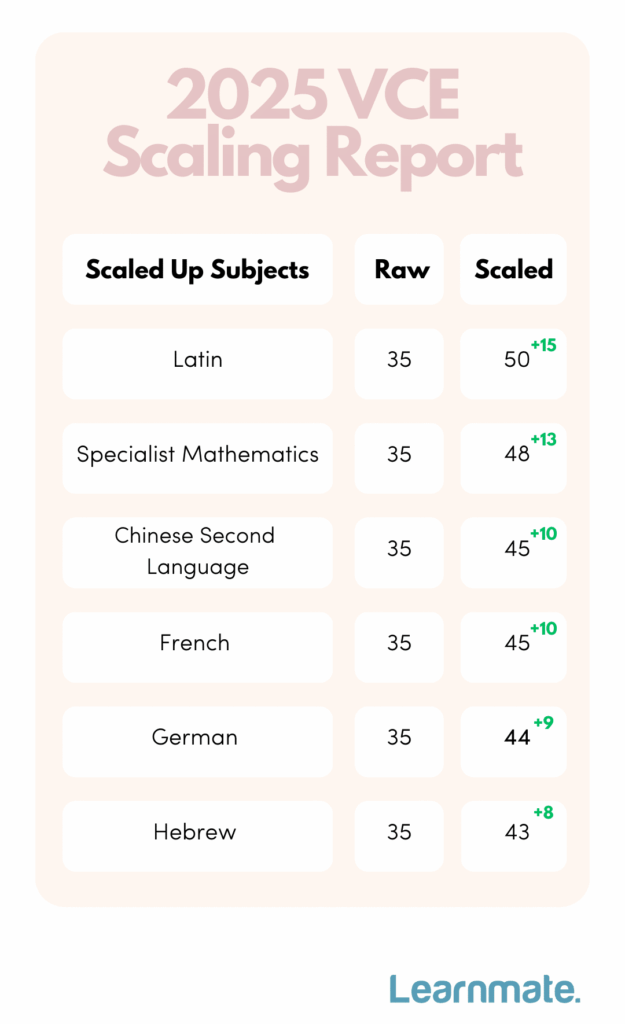
Top Subjects for Scaling Up
| Subject | Raw 35 | 2025 Scaled |
|---|---|---|
| Latin | 35 | 50 |
| Specialist Mathematics | 35 | 48 |
| Chinese Second Language | 35 | 45 |
| French | 35 | 45 |
| German | 35 | 44 |
These subjects often attract high-performing students and the strong upward scaling reflects the significant skill and effort required to excel in these subjects.
Top Subjects for Scaling Down
| Subject | Raw 35 | 2025 Scaled |
|---|---|---|
| Visual Communications Design | 35 | 32 |
| Sociology | 35 | 31 |
| Outdoor & Environmental Studies | 35 | 30 |
| Agricultural & Horticultural Studies | 35 | 29 |
| Foundation Maths | 35 | 26 |
These subjects are generally more practical or less technical alternatives to more complicated sister subjects and the downward scaling generally reflects the less competitive nature and lower technical skill and effort required.

How Popular Subjects Scaled in 2025
While not all popular subjects scale highly, many remain essential for tertiary prerequisites and broad skill development. Performing well in these subjects can still contribute strongly to your ATAR — even if scaling adjusts the score slightly.
2025 Scaling for Common VCE Subjects
| Subject | Raw 35 | 2025 Scaled Score | Raw 45 | 2025 Scaled Score |
|---|---|---|---|---|
| English | 35 | 33 | 45 | 45 |
| Psychology | 35 | 34 | 45 | 45 |
| General Mathematics | 35 | 33 | 45 | 44 |
| Mathematical Methods | 35 | 41 | 45 | 49 |
| Chemistry | 35 | 39 | 45 | 47 |
| Biology | 35 | 36 | 45 | 46 |
| Legal Studies | 35 | 34 | 45 | 45 |
Strong performance in these subjects is often easier to maintain due to their accessible content or alignment with student strengths, even if scaling adjustments are modest. Furthermore, these subjects could form a strong core for your subject selection as achieving at the upper end of your cohort (ie. a 45) rarely sees you penalised, with only modest or no scaling at that range (for instance, Legal Studies, Psychology and General Maths only scaled down by 1 or not at all for students who scored a 45 in 2025).
Should You Choose Subjects Based on Scaling?
Choosing a subject only because it scales well can be risky, but it can form part of a strategy to perform well in 2026 or beyond. What needs to be considered is that high-scaling subjects are usually scaled as such because they often come with:
- Heavy workloads,
- Technical complexity, and
- Strong competition
Students generally achieve better outcomes when they choose subjects they genuinely enjoy and feel confident in, even if those subjects scale down slightly. High raw performance nearly always beats relying on scaling alone and high raw performance (for example-sake, around a 45 raw study score), is rarely penalised, even for relatively easier subjects (see discussion above).
According to our research, students who selected subjects that aligned with their interests and strengths were significantly more likely to achieve higher ATARs, a result of having a more genuine and natural understanding, enthusiasm and energy to engage with that subject.
Subject Trends That Defined the 2025 VCE Cohort
Strong Scaling Performance in Languages
Languages remained dominant in the 2025 scaling tables, with several subjects leading students who scored a raw 35 or around that mark to exceed 40+ after adjustment:
- Latin (35 → 50)
- Chinese Second Language (35 → 45)
- French (35 → 45)
- German (35 → 44)
- Hebrew (35 → 43)
Students continue to be heavily rewarded for taking on the challenge of these second languages as part of their subject mix.
STEM Subjects Showed Competitive Cohorts
The more challenging maths subjects, as they have historically, continued to scale strongly and reward students for taking them on:
- VCE Specialist Mathematics (35 → 48)
- VCE Mathematical Methods (35 → 41)
Other STEM pathways, including the sciences, also provided a strong reward to students for solid performance in 2025:
- Algorithmics (35 → 43)
- Chemistry (35 → 39)
- Physics (35 → 37)
Creative and Humanities Subjects Remained Steady
These creative and Humanities subjects generally saw minor upward or downward adjustments for students in 2025:
- Psychology (35 → 34)
- Business Management (35 → 32)
- Literature (35 → 36)
- History Revolutions (35 → 34)
- VCD (35 → 32)
- Media (35 → 32)
VCE VET Subjects Continued Modest Scaling
VET programs typically saw neutral or downward scaling to recognise they are less academically challenging subject selections than the core VCE curriculum, consistent with previous years:
- VET Engineering (35 → 35)
- VET Business (35 → 28)
- VET Health streams (35 → ~30–32)
These scaling adjustments reflect the diverse candidature of VET and the more practice-based study pathways it offers.
Tips for Maximising Your ATAR in 2026
Here's Learnmate's top tips for performing well in 2026 based on the VCAA's 2025 Scaling Report and our own proprietary research:
- Play to your strengths: Pick subjects you enjoy and more naturally perform well in.
- Understand scaling: Know how your subjects are typically adjusted and try to have a balanced subject mix.
- Seek support early: Tutors can help build confidence and improve SAC and exam performance.
- Manage your workload: Balance demanding subjects with subjects you enjoy or maintain a well-balanced study routine to avoid burnout over the year.
- Stay consistent: Regular study habits outperform last-minute cramming every time.
Leverage Resources
You can also tap into free resources from companies like Learnmate and expert tutors who know how to succeed in VCE. For instance:
- Past Exams: You can access a collection of past VCE exams and examiner reports to hone your exam skills;
- Read Guides: Such as Learnmate's How to Get the ATAR You Need Guide;
- Tutor Tips: Seek out tutors, such as qualified teachers and former students who excelled, for tutor tips on how to do well in your subjects or how to study to achieve a high ATAR;
- Hire a tutor: Our research shows that 7 out of 10 students who achieve a high ATAR had a private tutor during Year 12. They are experts who know how to tackle the problems and difficulties you will face during the year.
Conclusion
Scaling ensures fairness across the VCE by recognising the difficulty and competitiveness of different subjects. By understanding how scaling works and choosing subjects aligned with your strengths, you can build a study program that maximises your ATAR in 2026.
Whether you're aiming to do high-scaling subjects like Specialist Mathematics and Chinese, to perform your best in widely chosen subjects like Psychology and English, or put together a balanced strategy to succeed in VCE, Learnmate can help to provide you with confidence, consistency, and smart planning.
Ready for support? Browse VCE tutors on Learnmate to start putting together your plan to succeed in 2026.